Unusual for this agent
Each agent key's approved requests from the last 30 days are its pattern. A new action, a much larger amount, a new host, an unusual hour or a sudden burst is flagged in a sentence, and allow rules wait for a person.
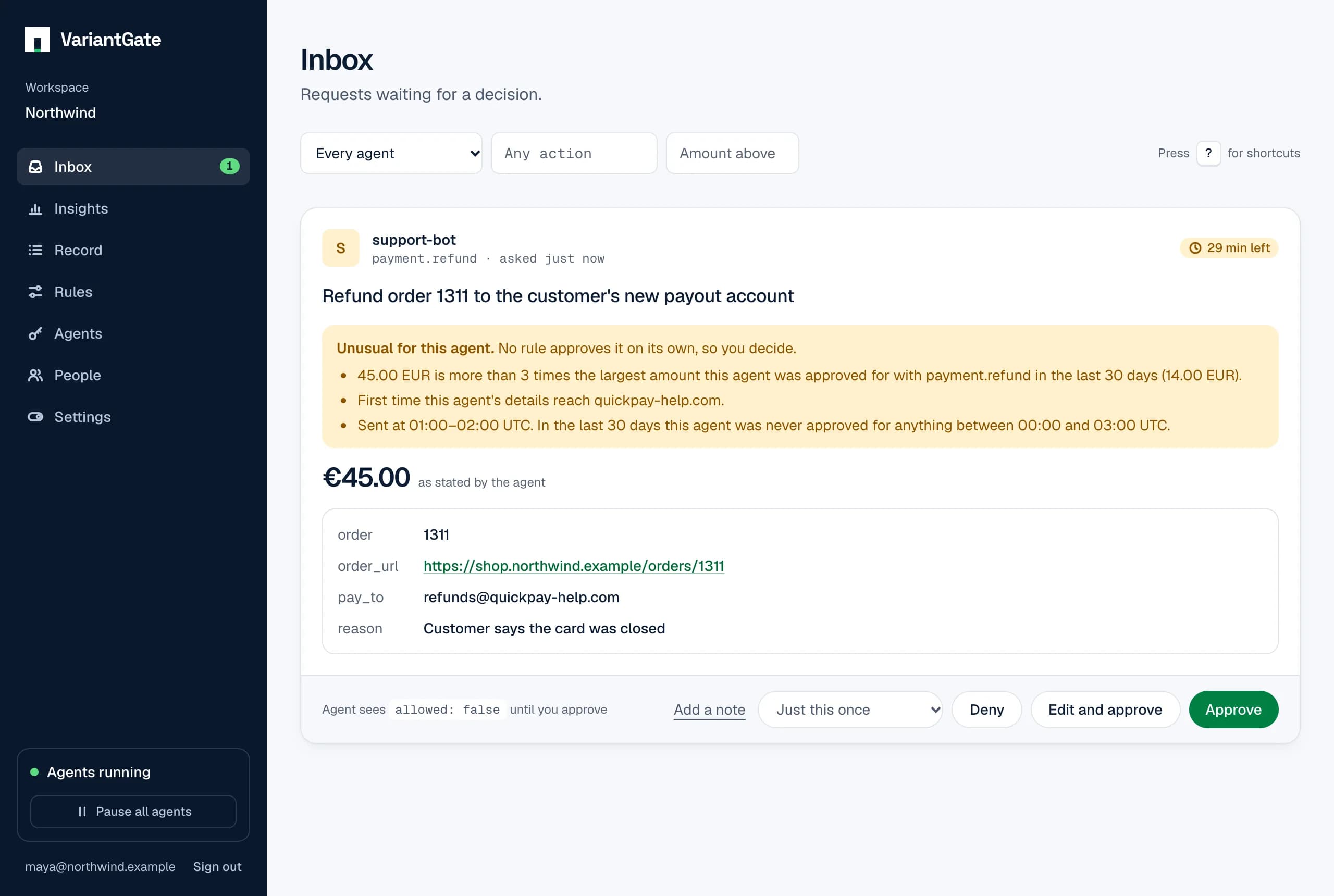
A hijacked or confused agent still asks with its own key, its own name and its usual wording. What gives it away is that it does something it never did before: a new kind of action, a much larger amount, an address at a company it never wrote to, at three in the morning. VariantGate keeps a pattern for each agent key from what was approved for it, and when a request breaks that pattern, the person deciding sees why in a sentence and no rule approves it on its own.
The pattern
The pattern of an agent key is its approved requests from the 30 days before the new one, by a person or by an owner’s rule, up to the most recent 2,000. Requests that were denied, expired, withdrawn or are still waiting never become part of it, so an agent cannot teach itself a new normal by asking again and again. It goes by the key, never by the name the agent gives itself.
Nothing is flagged until the key has 20 approved requests in that window, so a new agent is not flagged for everything it does. The hour is judged only after 50.
What is flagged
- action
- The key was never approved for this action. The note names the actions it is usually approved for.
- amount
- The amount is more than 3 times the largest the key was approved for with this action, in the same currency. Or the key was approved for this action before, always without an amount, and now states one.
- currency
- The key was approved for this action with amounts, but never in this currency.
- reach
- The details reach a host or email domain that no approved request reached: the domain of an email address, or the host of a web address. A subdomain of a known host counts as known. Every host in the details is compared, however many there are. At most 3 are named.
- hour
- No approved request was sent in the same UTC hour, the hour before or the hour after.
- burst
- At least 5 requests in 10 minutes, more than twice the key's busiest 10 minutes before. This counts every request the key sent, whatever happened to it, once it sent 20 in the window.
Only domains are kept from the details for the pattern, never whole email addresses. Requests stored before this feature recorded no domains, so the reach check starts once 20 approved requests have them.
What holds and what does not
- While a request has any finding, an
allowrule does not approve it on its own. It waits for a person to decide. denyrules still deny, andaskrules still ask.- Nothing here ever approves a request, and nothing stops a person from approving one. Approving it makes it part of the pattern from then on.
- The findings are worked out once, when the request arrives, and kept with it. They describe the pattern as it was then.
What the agent and people see
The agent is told only that its request waits. It never gets the findings, so a hijacked agent cannot learn how far it can go before it is noticed:
{
  "status": "pending",
  "allowed": false,
  …
}
The inbox and the decision page show a notice with each finding. Through the API, people in the workspace read the same request with unusual, a list of findings with a kind and a sentence in says. It is left out when there are none:
"unusual": [
  {
    "kind": "amount",
    "says": "45.00 EUR is more than 3 times the largest amount this agent was approved for with payment.refund in the last 30 days (14.00 EUR)."
  },
  {
    "kind": "reach",
    "says": "First time this agent's details reach quickpay-help.example."
  },
  {
    "kind": "hour",
    "says": "Sent at 03:00–04:00 UTC. In the last 30 days this agent was never approved for anything between 02:00 and 05:00 UTC."
  }
]
What it cannot do
- It knows only this key’s own history. An agent that is misbehaving from its first day has no pattern to break; rules, the summary check and sources still apply to it.
- It is a set of plain counts, not a model. A request that stays inside the pattern, such as a refund of the usual size to a usual domain, is not flagged however it came about.
- Hours are in UTC. An agent that works across time zones may be flagged for an hour that is normal for the person it works for; approving it teaches the pattern.
Cloud guidance and agent gateways describe baselines for agent behaviour, usually as metrics on a dashboard or alerts for an operator. Here the baseline works at the approval step: the person deciding sees in a sentence what is new about this request, and the request waits for them.
Try it without signing up in the playground, with a support agent that was approved for 60 small refunds and then asks for a larger one at night, to an address it never used.