What an audit trail for AI agents should record
The six facts every agent action should leave behind, and why the vendor's own log is not enough.
· 5 min read
Sooner or later someone asks about a thing an agent did. A customer got an email they should not have. A payment went out twice. The question is always the same, and it is never “what did the model think?”. It is “who allowed this?”
If the answer takes a day of searching through chat histories and log files, there is no audit trail. Here is what one needs to hold so that the answer takes a minute.
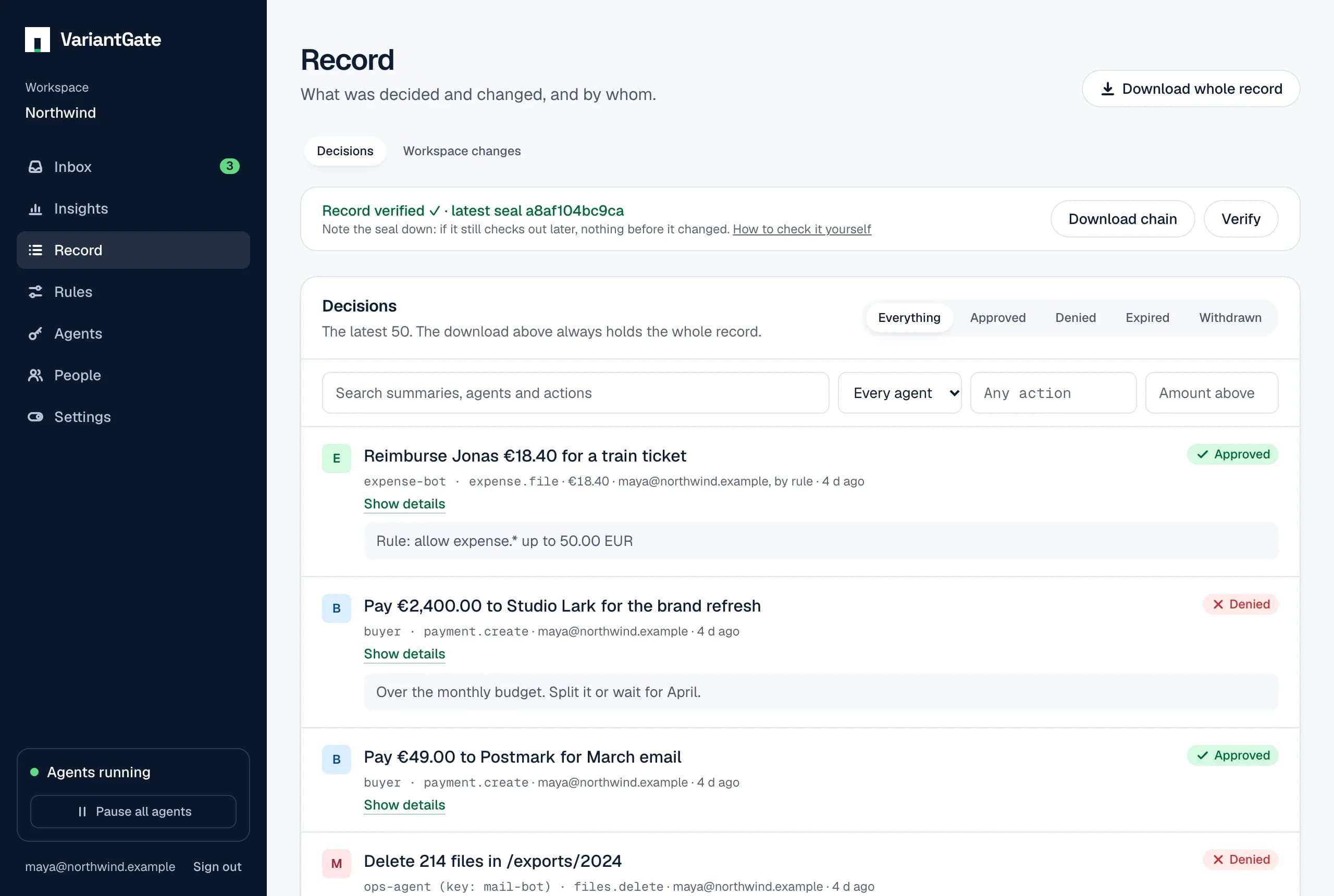
Six facts for every action
- Who asked
- Which agent, and which credential it used. The name an agent gives itself is not proof of anything.
- What for
- The action, and the exact words the person saw when deciding.
- The outcome
- Approved, denied, or expired with no answer.
- Who decided
- A named person. If a rule decided, the person who wrote the rule.
- Why
- The reason, when one was given. Most valuable on a no.
- When
- When it was asked and when it was settled.
The second row matters more than it looks. A record that stores what the agent did, but not what the person was shown, cannot tell a bad decision from a misleading request.
Why each tool’s own log is not enough
- There are several of them. One team can run a coding assistant, a support agent and a few scripts. That is three logs in three formats, and some live on a laptop.
- They record activity, not permission. A tool log says a command ran. It rarely says which person agreed to it.
- They belong to the thing being audited. A record the agent’s own process can write to is weaker evidence than one it can only add a question to.
Three properties to insist on
- Decisions are final. Nobody can turn a denial into an approval afterwards, or the other way round.
- Expired is recorded too. “Nobody answered” is an outcome, and it should be visible that the agent was told no.
- It can leave the system. An auditor wants a file, not a login. A CSV export that opens safely in a spreadsheet is enough.
What to be honest about
A record like this proves who allowed an action. It does not prove the agent then did exactly that and nothing else; for that, the check has to sit in the code that performs the action, as this guide shows.
And “cannot be changed through the product” is not the same as “provably never changed”. Ours is sealed: each entry carries a hash of the one before it, so changing, removing or reordering an entry breaks the chain, and anyone in the workspace can download it and check it without trusting us. Note the latest seal somewhere of your own. If the chain still checks out later and that seal is still in it, nothing before it changed.
Start before you need it
A record cannot be filled in afterwards. The day the question comes, it either holds the answer or it does not. The record docs describe what ours keeps and how to export it.