Approval fatigue is real. Standing rules fix it without giving up control
Asking about everything trains people to click yes. Standing rules keep the questions rare and meaningful.
· 5 min read
Anyone who has used a coding assistant knows the moment. The twentieth “May I run this command?” of the afternoon appears, and your hand has pressed yes before your eyes reached the end of the line. The approval step is still there. It has stopped doing anything.
That is approval fatigue, and it is the most common way a human-in-the-loop setup fails. Nothing breaks. The person simply becomes a slower way of saying yes to everything.
How to tell it is happening
- Requests are approved within a second or two of arriving.
- Almost nothing is ever denied.
- People ask for a way to approve everything at once, or leave the agent in a mode that does not ask.
The last one is the real danger. An approval step that annoys people gets switched off, and then there is no step at all.
The fix is fewer questions, not faster answers
A question is worth asking when the answer is sometimes no. If the answer to a request has been yes fifty times in a row, the person is not deciding anything, and the request should stop reaching them.
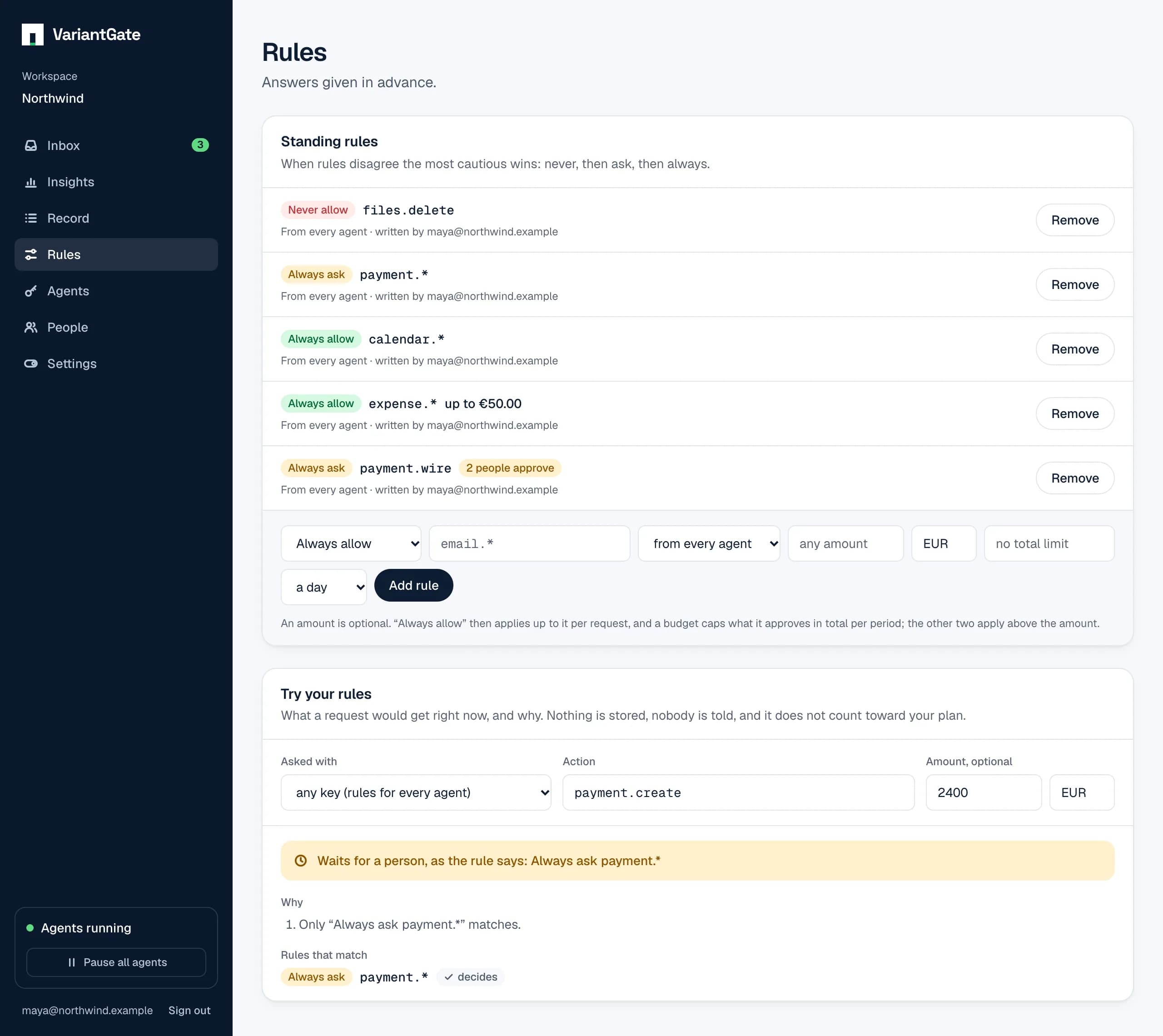
A standing rule does that. It is an answer given once, in advance, by someone allowed to give it:
- Always allow
- Approve a matching request at once. For the routine and reversible.
- Never allow
- Deny it at once. For what no agent should do, whoever asks.
- Always ask
- Send it to a person whatever other rules say. For money and anything public.
A way to get there
- Start by asking about everything risky. For a week, the inbox is noisy on purpose.
- Read the record. Which actions did you approve every time, without a second thought? Those become “always allow”.
- Which did you deny every time? Those become “never allow”, and the agent hears no at once instead of waiting.
- Put “always ask” on the families you never want a broad rule to swallow, such as
payment.*.
Rules without giving up control
The worry with rules is that they become the mode that does not ask under another name. Three properties keep that from happening:
- The most cautious rule wins. Never beats ask, and ask beats always. An “always allow everything” cannot undo a “never delete”, in whatever order they were written.
- A rule has an author. What a rule decides is recorded in the name of the person who wrote it, so every action still traces back to someone who said yes.
- A rule goes by the agent’s key. An agent cannot rename itself into another agent’s permissions.
A rule can also carry an amount. “Always allow payments up to €50” and “always ask about payments above €50” keep the small ones moving and put the large ones in front of a person. One honest limit: the amount is the one the agent states, so the code that pays must pay exactly what was approved.
What good looks like
A handful of requests a day, each one worth reading, and a record where the denials are real decisions. The rules docs have the details.